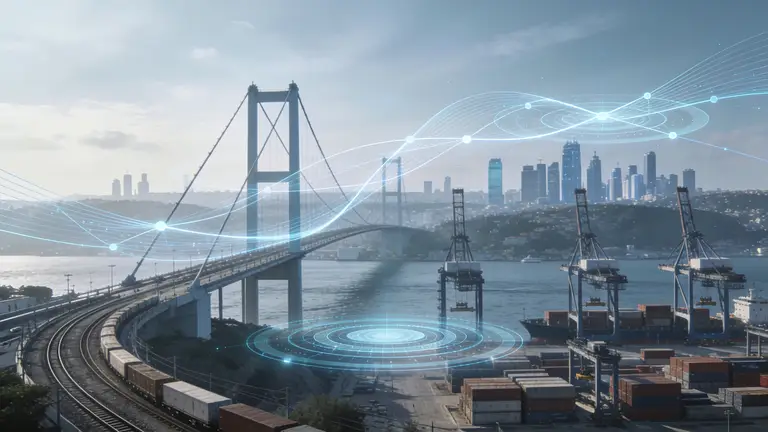
The Islamic Development Bank and Türkiye have signed a EUR 660 million financing agreement for the Istanbul North Rail Crossing Project, advancing one of the country’s largest transport investments and a potentially consequential piece of the emerging Europe-Asia logistics network. Signed at COP31 in Antalya on November 12, 2026, the agreement strengthens the financing base for a new railway across the Bosphorus that could raise cross-strait freight capacity from about 3 million tonnes to as much as 50 million tonnes a year. For international investors, the project matters not only as a major construction opportunity, but also as an attempt to reduce a persistent logistics constraint affecting manufacturing, distribution and regional trade through Türkiye.
A Landmark IsDB Transaction Within a Larger Financing Package
The Islamic Development Bank said its EUR 660 million commitment is its largest sovereign financing transaction with Türkiye and the first “Forward Lease” agreement between the two parties. IsDB describes forward leasing as a Sharia-compliant financing modality, although its announcement did not disclose the transaction’s pricing, maturity, repayment profile or asset-transfer arrangements.
The agreement follows IsDB board approval in June 2026 for EUR 660.35 million. It was signed during a COP31 ceremony at which Türkiye announced multilateral financing for 10 climate-related projects and programs worth approximately $5.1 billion. The government presented the portfolio as supporting low-carbon transport, resilient infrastructure, sustainable industry and its net-zero target for 2053.
INRAIL itself is much larger than the IsDB commitment. World Bank project documents estimate the total cost at $8.27 billion, including value-added tax, contingencies, land acquisition, supervision and project management. The World Bank approved a $2 billion loan in March 2026 and is coordinating a six-lender package expected to provide about $6.75 billion.
The Asian Development Bank approved $750 million in June, while the Asian Infrastructure Investment Bank approved financing of up to $1.5 billion. The European Bank for Reconstruction and Development has proposed a sovereign loan of up to EUR 500 million, and Asian Development Bank disclosures identify a planned $500 million contribution from the OPEC Fund for International Development. Türkiye is expected to provide counterpart funding, including roughly $1.5 billion for the main works component, according to World Bank appraisal documents.
This structure is significant for investors because the capital does not constitute foreign direct investment. It is sovereign-backed development finance. Its FDI relevance lies in how public infrastructure and multilateral procurement can crowd in private investment by lowering logistics costs, creating contracts for international suppliers and making industrial locations along the corridor more commercially viable.
A 127-Kilometre Bypass for Istanbul’s Rail Bottleneck
INRAIL will run from Çayırova on Istanbul’s Asian side to Çatalca on the European side, using the rail-designated deck of the existing Yavuz Sultan Selim Bridge at the northern end of the Bosphorus. It will also connect Istanbul Airport and Sabiha Gökçen International Airport with each other and with Türkiye’s national rail network.
The Ministry of Transport and Infrastructure’s Directorate-General of Infrastructure Investments, known as AYGM, describes the scheme as 122.3 kilometres of double-track main line plus 4.7 kilometres of connecting tracks. The resulting 127-kilometre system will be electrified and designed for mixed passenger and freight use, with speeds of up to 160 kilometres per hour.
The engineering scope is unusually complex. AYGM’s procurement notice identifies five twin-tube tunnel-boring-machine tunnels with a combined length of 36.2 kilometres, 22 tunnels using the New Austrian Tunnelling Method totaling 23.3 kilometres, 17 cut-and-cover tunnels, two viaducts and 40 bridges extending over 22.1 kilometres. Approximately half the alignment will therefore be underground.
That configuration is partly about climate resilience. The World Bank says tunnels reduce exposure to extreme heat, flooding, high winds and wildfires. The project also incorporates measures addressing rail buckling, overhead-line sag, drainage failure, erosion and bridge scour. These features explain why the financing agreement was highlighted at COP31, rather than treated solely as conventional transport spending.
The present cross-Bosphorus railway route depends heavily on the Marmaray tunnel, which opened in 2013 and was primarily designed for intensive urban passenger services. Freight trains are generally confined to limited nighttime operating windows. According to the World Bank, some rail shippers respond by transferring cargo to trucks before the Bosphorus, crossing Istanbul by road and then returning the shipment to rail. Others remain on the road network altogether.
The economic consequences are material. World Bank research found that only 5 percent of Türkiye’s inland freight moved by rail in 2024, compared with 17 percent in the European Union. Less than 1 percent of the country’s foreign trade used rail border crossings, while trucking in Türkiye was estimated to cost 2.8 times more per tonne-kilometre than rail. Logistics costs were equivalent to about 14 percent of company sales, compared with 10 percent in the EU.
From Construction Project to Trade-Corridor Strategy
The investment case extends beyond Istanbul. INRAIL is intended to serve three international systems: the Trans-Caspian Transport Corridor, commonly called the Middle Corridor, the proposed Iraq Development Road and the Türkiye-EU corridor.
The Middle Corridor links China and Central Asia with Europe through the Caspian Sea, the South Caucasus and Türkiye. A September 2026 World Bank report estimated that coordinated investments and reforms could more than triple trade volumes on the corridor, halve journey times, increase participating countries’ aggregate gross domestic product by 3.3 percent and create two million additional jobs by 2040. Achieving that scenario would require more than $25 billion in physical infrastructure and another $30 billion for rolling stock, logistics terminals, connecting infrastructure and digital systems.
The Iraq Development Road is intended to connect the Gulf and the Iraqi port of Al Faw with Türkiye and Europe. Its commercial prospects remain dependent on cross-border coordination, security, financing and construction progress in Iraq. INRAIL cannot resolve those uncertainties, but it would remove a major Turkish bottleneck if the corridor becomes operational.
The EU connection has the most immediate relevance. World Bank appraisal documents report that the Türkiye-EU corridor accounted for 41 percent of Türkiye’s merchandise exports and 32 percent of imports in 2024. TurkStat subsequently recorded Turkish goods exports of $273.4 billion and imports of $365.4 billion in 2025. For industrial companies serving European customers, improved rail reliability could support lower inventories, more predictable delivery schedules and greater use of intermodal logistics.
The airport connection adds another investment dimension. Istanbul Airport handled 1.6 million tonnes of freight in 2023, of which 97 percent was international, according to the World Bank. Connecting it and Sabiha Gökçen to the national railway could encourage new cargo terminals, warehousing, cold-chain facilities and time-sensitive manufacturing clusters. Realizing those benefits will still require well-planned last-mile links, train paths, terminals and commercially attractive service schedules.
Procurement Opens a Direct Route for International Participation
AYGM has divided the main design-and-build procurement into four lots, covering Çayırova to Sabiha Gökçen Airport and Kurtdoğmuş, Kurtdoğmuş to Alibahadır, Alibahadır across the Yavuz Sultan Selim Bridge to Mithatpaşa, and Mithatpaşa through Istanbul Airport to Çatalca.
The competition is being conducted under the World Bank’s September 2025 procurement regulations and is open to eligible international bidders. AYGM has selected a single-stage, two-envelope process in which technical and financial proposals are submitted separately. Contracts are expected to use the 2017 FIDIC Yellow Book for plant and design-build works, with lender-specific amendments.
The procurement page had received multiple addenda and technical updates through November 6, 2026. No contract award was publicly identified there as of November 14. That distinction is important: secured financing substantially improves implementation prospects, but it does not eliminate tender, design, permitting, land-access or construction risk.
Large international contractors will need to assess qualification requirements, consortium structures, bonding, insurance, currency exposure, taxation and local subcontracting capacity. Equipment suppliers must evaluate import procedures, conformity rules and customs treatment. Companies intending to maintain a long-term presence may need Turkish incorporation, employment arrangements and registrations rather than operating only through an offshore contracting entity.
These are areas where market-entry planning, company incorporation and corporate structuring, legal and tax compliance, import-export facilitation and project management become operational requirements. Government relations also matters, not as a substitute for formal procurement, but for coordinating transparently with AYGM, municipalities, utilities, regulators and other public bodies whose approvals can affect execution.
Environmental and Delivery Risks Remain Substantial
Multilateral participation brings long-tenor financing and harmonized procurement, but also demanding safeguards. The EBRD classifies INRAIL as Category A, while the World Bank assesses its environmental and social risk as substantial. Identified issues include land acquisition, economic displacement, forest and water impacts, biodiversity, noise, vibration, groundwater, spoil disposal, cultural heritage, worker safety and community disruption.
The planned alignment reduces some exposure by following existing infrastructure corridors and using tunnels, viaducts and public land. World Bank documents indicate that expropriation should not be required along 81 percent of the alignment. Even so, resettlement plans must be prepared once final designs define the precise land footprint, and contractors will need site-specific environmental and social management systems before construction.
Cost and schedule management will be equally important. The project’s targeted closing date is 2033, leaving a long period during which inflation, exchange rates, geological conditions and supply-chain pressures could alter commercial assumptions. Signalling and telecommunications are also expected to be tendered separately from the main civil works, creating interface risks between contractors.
What This Means for Foreign Investors
INRAIL strengthens Türkiye’s logistics proposition, but investors should treat the EUR 660 million IsDB agreement as an enabling milestone rather than proof that all commercial benefits are imminent. The railway’s value will depend on timely construction, competitive track access, effective border procedures, adequate rolling stock and coordinated services across the wider Middle Corridor and European network.
Foreign contractors and suppliers should begin with tender-specific market-entry analysis, local-partner due diligence and a clear decision on whether to bid directly, form a consortium or establish a Turkish entity. Incorporation and corporate structuring must be aligned with tax, staffing, liability and procurement requirements. Legal and tax compliance reviews should cover the FIDIC framework, lender integrity rules, Turkish construction law, employment obligations and indirect taxes.
Manufacturers, logistics companies and terminal developers should model sites and volumes around realistic commissioning phases rather than headline capacity. They should also examine investment incentives available for logistics, machinery, rolling stock, warehousing and export-oriented production, while confirming eligibility before committing capital. Import-export planning will be necessary for specialized machinery and rail systems, and project management support will be critical where construction, licensing, customs and local procurement must proceed in parallel.
For investors not participating in the railway contracts, the larger opportunity is strategic. A reliable northern Bosphorus crossing could change the economics of locating production and distribution operations in Türkiye. Capturing that advantage will require disciplined market entry, regulatory liaison, incentives analysis and on-the-ground execution, the areas in which an FDI advisory firm such as fdiconsultancy.com can translate a national infrastructure project into an investable operating plan.
Related insights
FDI Consultancy
Ask about this topic
Tell us about your plans in Türkiye. The topic is filled in from this article, and you can edit it. We use these details only to reply. Read the privacy policy.
Message sent
Thank you for reaching out. We will get back to you as soon as possible.