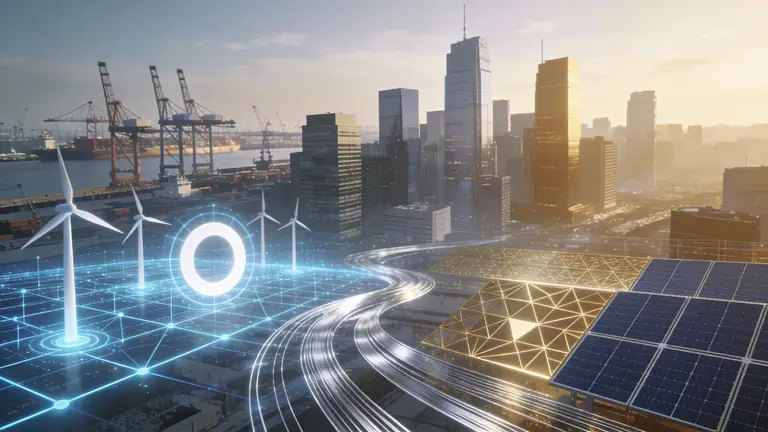
Türkiye will need an estimated $160 billion to $165 billion by 2053 to deliver its energy transition, according to S&P Global Ratings, a financing requirement that places foreign capital at the center of the country’s decarbonization and energy-security strategy. Yet the headline number captures only part of the challenge. Ankara’s newer energy plan envisages far broader investment in generation, grids, electrification and nuclear power, while investors must contend with constrained transmission capacity, evolving support mechanisms, local-content rules and Türkiye’s continuing commitment to coal.
A $160 Billion Estimate With a Wider Context
Beth Burks, Director of Sustainable Finance Markets at S&P Global Ratings, told Bloomberg HT on November 17 that Türkiye would require about $160 billion through 2053 to meet its energy-transition objectives. She also described a global climate-finance market in which public funding of roughly $300 billion annually is expected to help mobilize far larger private flows, with a target of $1.3 trillion.
The estimate is consistent with an S&P Global analysis published before COP31 in Antalya. Citing Türkiye’s Climate Change Mitigation Strategy and Action Plan and its 2053 Long-Term Climate Strategy, S&P put cumulative requirements at $160 billion to $165 billion. Approximately $85 billion to $90 billion would be needed by 2035, primarily for power-sector modernization, renewable generation and energy efficiency.
S&P’s figures should not be read as a comprehensive price tag for every component of Türkiye’s future energy system. In November 2026, Energy and Natural Resources Minister Alparslan Bayraktar presented a National Energy Plan to 2040 that envisages about $500 billion of investment over 13 years. According to the Associated Press, roughly $210 billion would be undertaken by Turkish public-sector companies, with much of the remainder expected to come from foreign investment.
The apparent difference reflects varying scopes and methodologies. The $160 billion to $165 billion estimate focuses on defined transition measures under existing climate strategies. The government’s larger figure appears to encompass broader electrification, nuclear power, transmission, distribution and other energy-security investments. For international investors, the more important conclusion is that Türkiye is preparing a multidecade project pipeline too large to be financed through domestic public resources alone.
Renewables, Grids and Electrification Drive the Opportunity
Türkiye’s 2035 Renewable Energy Roadmap calls for combined wind and solar capacity to reach 120 gigawatts, up from roughly 30 GW when the target was announced in 2024. The Energy Ministry initially associated the program with approximately $80 billion of generation investment. Government estimates cited by energy think tank Ember indicate that another $28 billion could be required for grid expansion.
The scale-up is already visible. The Turkish Investment and Finance Office reported that Türkiye added 6.2 GW of net power capacity in 2025, with renewables accounting for 99 percent of additions. Ember calculated that wind and solar additions reached a record 6.5 GW during the year. Even that pace must accelerate, however, because reaching the 2035 target requires around 8 GW of additional wind and solar capacity annually.
The investment opportunity extends beyond utility-scale generation. The Treasury and Finance Ministry’s September 2026 sustainable-finance presentation set targets of 2.1 GW of battery capacity by 2030, 5 GW of electrolyzer capacity by 2035 and 70 GW of electrolyzers by 2053. The same strategy envisages renewables providing 50 percent of primary energy by 2053, compared with 18.6 percent in 2024, while nuclear power rises to 29.3 percent.
Transport and industrial electrification will add another layer of demand. Bayraktar said Türkiye aims to lift electrification to 36 percent by 2040 and increase the number of electric vehicles from about 500,000 to 20 million. This creates opportunities in charging infrastructure, battery systems, demand management, industrial heat, energy-efficiency services and digital grid technologies, not only in power plants.
The economic rationale is also tied to Türkiye’s external balance. S&P Global estimates that imported fuels provide about 70 percent of the country’s primary energy supply. Replacing imported gas with domestic wind and solar can therefore reduce exposure to commodity-price shocks and pressure on the current account. The Energy Ministry said the 1.5 GW of wind capacity allocated through the November 2026 YEKA auctions could produce 4.6 billion kilowatt-hours annually and avoid approximately $852 million of natural-gas imports each year.
Foreign Capital Is Already Moving In
Türkiye attracted 28 announced renewable-energy FDI projects with capital expenditure of $1.6 billion in 2025, according to the Investment and Finance Office’s 2025 FDI Projects Report. Wind accounted for $985 million and solar for $577 million. The Netherlands was the principal source of wind investment, while China led solar-generation projects.
Foreign investment also entered the equipment supply chain. The same report recorded $1.17 billion of announced investment in solar-cell manufacturing and $345 million in battery-cell projects. German and Chinese companies led solar-cell commitments, while US investors led the battery category. This suggests that Türkiye could capture value from both electricity production and the manufacturing needed to support regional deployment.
Multilateral institutions are helping reduce financing risk. The European Bank for Reconstruction and Development invested a record €2.7 billion in Türkiye in 2025, with 66 percent supporting the green transition and 91 percent directed to the private sector. Transactions included a $200 million loan for Enerjisa Üretim’s 250 MW wind program and €280 million deployed through participating banks under green-economy financing facilities.
In June 2026, the World Bank approved €400 million in additional financing for Türkiye’s distributed renewable-energy market, extending support to distributed wind and commercial battery storage. The financing built on a program initiated in 2024 for low-voltage distributed solar.
Strategic state-to-state transactions are emerging alongside conventional project finance. At COP31, eight development and commercial financial institutions signed a support letter for ACWA Power’s planned 2 GW Sivas and Taşeli solar projects. The projects represent the first phase of a wider 5 GW Türkiye-Saudi Arabia renewable-energy package, according to the Energy Ministry.
These transactions demonstrate that finance is available where projects combine bankable revenue arrangements, credible sponsors and manageable regulatory risk. They do not yet prove that capital can be mobilized at the pace required across thousands of megawatts of smaller or less politically supported projects.
Auctions Improve Visibility, but Bankability Varies
Türkiye uses several routes to renewable development, including Renewable Energy Resource Zone auctions, known as YEKA, storage-integrated licenses, hybrid plants and unlicensed self-consumption projects.
The European Commission’s 2026 Türkiye report said the country awarded close to 3.8 GW of wind and solar capacity through YEKA processes during 2025. In November 2026, the government completed another 1.5 GW wind auction covering seven sites in Sivas, Balıkesir, Manisa and Kütahya. Twelve companies submitted 29 bids.
Winning projects can sell power on the merchant market for 72 months after signing, followed by a 20-year purchase period at 3.50 euro cents per kilowatt-hour. The euro-denominated structure limits part of the currency mismatch that can undermine emerging-market infrastructure projects, although exposure remains during construction and the initial merchant period.
Revenue support differs by project type and award date. S&P Global noted that the broader YEKDEM renewable-support mechanism moved from US dollar-indexed to Turkish lira-based tariffs, reducing its attractiveness to some international investors. Foreign sponsors must therefore model each opportunity individually, considering tariff indexation, financing currency, merchant-price exposure, inflation and equipment-import costs.
Sustainable capital markets could provide an additional channel. Burks told Bloomberg HT that global green-bond issuance has matured to around $1 trillion annually. Türkiye’s Capital Markets Board adopted updated guidelines for green, sustainable, social and sustainability-linked instruments in August 2026, including reduced regulatory fees. This improves the framework for refinancing operating assets, but green labels cannot substitute for sound project economics or predictable regulation.
Grid Access and Policy Consistency Remain the Tests
Transmission capacity is the immediate physical constraint. Ember reported that approximately 33 GW of storage-integrated wind and solar projects had received preliminary licenses, but only around 208 MW was operating by early 2026. Unlicensed projects also faced an absence of available provincial connection capacity from July 2025, before the government announced 3.5 GW of new capacity in March 2026.
Permitting is another bottleneck. Reforms enacted in 2025 aim to reduce approval periods to approximately 18 months, from as long as four years for wind projects. Implementation will determine whether the reform accelerates development without weakening environmental assessments, land rights or public consultation.
International developers must also evaluate localization requirements. The European Commission has repeatedly argued that Türkiye’s renewable-energy local-content practices can conflict with World Trade Organization and EU-Türkiye Customs Union obligations and disadvantage foreign suppliers. Investors may need local procurement, manufacturing or joint-venture structures to compete effectively, making supply-chain design as important as resource quality.
Climate-policy direction is improving but remains internally divided. Türkiye enacted Climate Law No. 7552 in July 2025 and is developing an emissions-trading system aligned partly with the EU Carbon Border Adjustment Mechanism. That could support demand for low-carbon electricity among exporters of steel, cement, aluminum and other carbon-intensive products.
At the same time, Türkiye has not adopted a formal coal phaseout date. Ember says coal still provides about one-third of electricity and has criticized an estimated $8.7 billion purchase guarantee announced for domestic coal plants in 2025. S&P Global similarly warned that continued coal support sits uneasily beside the 2053 net-zero objective. Investors must therefore distinguish between Türkiye’s strong commitment to adding low-carbon capacity and a less certain timetable for retiring fossil assets.
What This Means for Foreign Investors
Türkiye’s energy transition offers a substantial FDI pipeline, but access will depend on more than identifying high-quality wind or solar resources. Market-entry work must compare YEKA auctions, licensed storage projects, industrial self-consumption, equipment manufacturing and acquisition opportunities, each of which carries different revenue and regulatory characteristics.
Corporate incorporation and structuring require careful treatment of licensing eligibility, shareholder arrangements, financing currency and bilateral investment protections. Investment-incentive analysis must determine how national and regional programs interact with customs exemptions, VAT treatment, local-content conditions and support for manufacturing or research facilities.
Legal and tax compliance will become more demanding as the Climate Law, emissions trading, environmental approvals and EU-related carbon reporting develop. Government-relations and regulatory liaison are particularly relevant for grid connection, Energy Market Regulatory Authority processes, ministry approvals, land access and auction participation.
Import-export facilitation matters for turbines, modules, inverters, batteries and specialized components, especially where customs treatment and localization rules influence project economics. Project management is equally critical after an award, when sponsors must coordinate engineering, procurement, grid works, permitting, finance and local contractors against binding milestones.
The $160 billion estimate identifies the scale of Türkiye’s transition challenge. The larger government investment plan shows that the addressable market may be considerably broader. Foreign investors that translate national targets into bankable, compliant and executable projects will be best placed to participate, while those relying on headline capacity goals alone risk underestimating the importance of grid access, policy design and on-the-ground delivery.
Related insights
FDI Consultancy
Ask about this topic
Tell us about your plans in Türkiye. The topic is filled in from this article, and you can edit it. We use these details only to reply. Read the privacy policy.
Message sent
Thank you for reaching out. We will get back to you as soon as possible.